What does personal liability coverage do?
Coverage E may help when someone claims that you or another insured person caused bodily injury or property damage. It may pay covered legal defense costs and damages.
Quick answers
What is Coverage E, and when does it come into play?
Coverage E, personal liability, protects you and the people who live in your household against claims that you’re legally responsible for someone else’s bodily injury or property damage. It applies to accidents connected to your home: a guest slipping on a wet pool deck, a delivery driver tripping on a loose step. On most standard Florida forms, it also covers certain non-business activities of household members even away from the property, such as a child accidentally breaking a neighbor’s window.
Coverage E only pays out once negligence or legal liability is established, whether through a settlement or a court judgment. It is not a substitute for medical payments coverage (Coverage F), which pays small medical bills regardless of fault. On the standard ISO HO-3 form used as the base for most Florida policies, Coverage E also pays the legal defense costs of a covered liability claim. Those costs are typically paid in addition to the liability limit rather than eating into it, though the exact wording varies by carrier. It’s worth confirming on your own policy.
What liability limits do Florida carriers commonly offer?
Most Florida HO-3 and HO-6 policies carry a base Coverage E limit, and $100,000 per occurrence is a common starting point on many carriers’ base forms. From there, carriers typically let you select a higher limit: $300,000 and $500,000 are widely offered options, and a number of carriers make $1 million available as the top liability tier on the homeowners policy itself.
Which limit makes sense depends on what you’re protecting: your assets, your income, and risk factors like owning a pool or a dog. Exact limit options, and any surcharge tied to raising them, differ by carrier and aren’t uniform across the state, so check the specific carrier’s carrier profile or your quote for the options on the table.
How do dogs, pools and trampolines interact with liability coverage?
Dogs. Dog bite claims are typically covered under Coverage E like any other liability claim. But many Florida carriers apply breed-based restrictions, require a signed liability exclusion for certain dogs, or decline to write or renew a policy if they consider a dog on the property higher-risk. Some carriers underwrite on bite history rather than breed. This practice varies significantly from carrier to carrier and changes over time, so treat any specific breed list you find as a starting point to verify with the carrier directly, not a rule that applies site-wide.
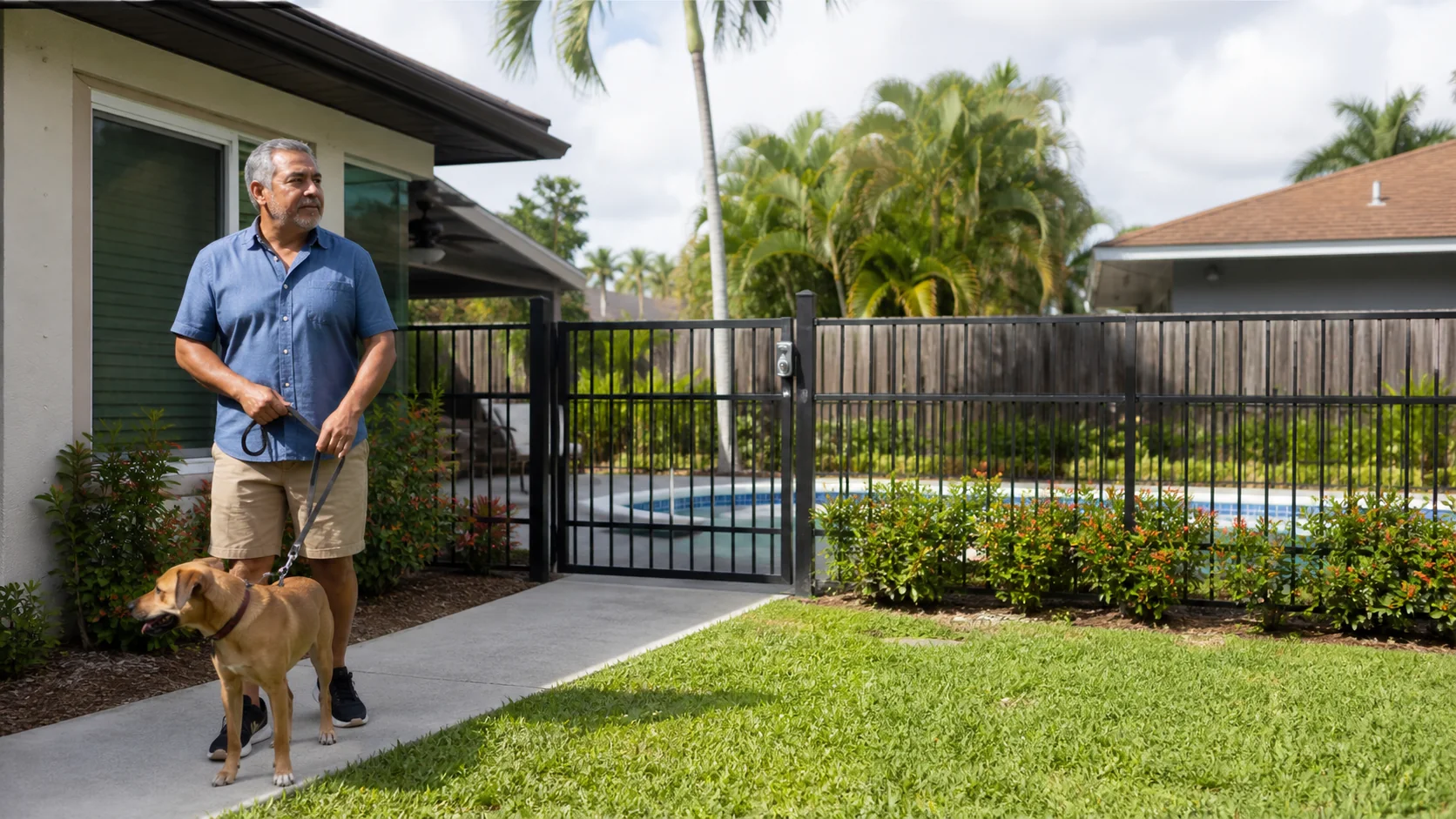
Pools. Insurers generally treat a pool as an attractive nuisance and often require safety features before extending full coverage, commonly a self-latching, self-closing fence around the pool area, and sometimes a pool alarm or safety cover. Diving boards and slides are excluded outright by some carriers. A pool enclosure built to Florida code can work in your favor during underwriting.
Trampolines. Carrier approaches range widely: some will insure a trampoline if it has a full net enclosure and is anchored correctly, some will insure the home but attach an exclusion rider carving out trampoline-related injuries specifically, and others decline to write or renew a policy altogether if one is present. Confirm the carrier’s actual position before installing one, rather than assuming it’s covered.
What is typically excluded from personal liability?
Coverage E has standard carve-outs on nearly every Florida homeowners policy:
- Intentional or criminal acts by an insured: liability coverage generally responds to accidents, not deliberate harm.
- Business or professional activities conducted from the home, which usually need a separate business liability policy or endorsement.
- Motor vehicles, boats and aircraft. These are handled by their own auto, watercraft, or aviation liability policies, though some homeowners forms extend limited coverage to small, low-powered watercraft.
- Injuries to the insured or to other residents of the same household. Coverage E responds to claims from outside the household, not injuries among the people who live there.
- Property damage that falls under Coverage A through D, since those sections insure your own dwelling, other structures, and belongings, not third-party liability.
Specific exclusion wording differs by carrier and by endorsement, so the declarations and exclusions pages of your actual policy govern over any general summary.
How does an umbrella policy sit on top of Coverage E?
A personal umbrella policy provides additional liability protection that sits above, and only above, the limits of your homeowners and auto policies. It doesn’t replace Coverage E; it extends it once the underlying limit is exhausted.
Umbrella carriers generally require you to carry a minimum underlying liability limit on your homeowners policy before they’ll issue the umbrella. $300,000 in Coverage E is a commonly cited minimum, alongside minimum auto liability limits. Requirements vary by umbrella carrier, so the exact underlying figure needed should be confirmed with whichever company is writing the umbrella. Once that threshold is met, umbrella coverage typically adds liability protection in increments of $1 million and up. In some cases it can also broaden coverage for claim types, such as libel or slander, that a standard homeowners policy handles narrowly or not at all, subject to that umbrella policy’s own language.
Where do liability limits show up on the declarations page?
Your Coverage E limit is listed on the declarations (dec) page, in the coverage summary alongside Coverage A through D, usually shown as a per-occurrence dollar amount. Coverage F, Medical Payments to Others (a smaller, no-fault sublimit that typically runs from around $1,000 to $5,000 per person) is generally listed directly beside it.
If the dec page shows only the carrier’s base Coverage E amount, that’s often the default limit rather than a limit chosen to match your specific exposure. Comparing the dec page number against the limit you asked for is a quick way to catch a mismatch before a claim, not after one.
Frequently asked questions
Does Coverage E cover an injury to someone who lives in my household?
No. Liability coverage is written for claims from people outside the household. An injured resident generally isn’t a Coverage E claimant on their own policy.
Does Coverage E cover my dog if it bites someone away from my property?
Often yes, since liability coverage on most standard forms extends to certain incidents away from the insured premises, but this is subject to the policy’s own wording and to any breed-based exclusion the carrier has applied, so it needs to be checked on the actual policy rather than assumed.
Is Coverage E the same on a condo (HO-6) policy as on a homeowners (HO-3) policy?
The underlying concept is the same, liability protection for injury or damage you’re legally responsible for, though the surrounding coverages and limits on an HO-6 differ from an HO-3, so the two aren’t identical policies with a shared Coverage E number.
How much liability coverage is enough?
There’s no single figure that fits every household; it typically comes down to matching the limit to the assets and income you have to protect, plus known exposures such as a pool or a dog, and raising it (or layering an umbrella on top) accordingly.
Does a Coverage E claim affect my ability to renew?
It can. A liability claim, and a dog bite claim in particular, is something carriers may weigh at renewal or when underwriting a new policy, and practices differ by carrier.
Do I need a separate policy for a pool or trampoline?
Not necessarily a separate policy, but you may need to meet specific safety requirements, accept an exclusion rider, or in some cases be declined by a given carrier. Confirm the carrier’s actual position before assuming either feature is covered as-is.
 Need a specific insurance company?
Get a quote from your Florida-licensed agent
Share a few details about your home, and our team will follow up to review your request and explain the next step.
- Florida-licensed agent
- Help with all property types
- No obligation
- Quotes typically back within 24 to 48 hours