Why does construction type affect home insurance?
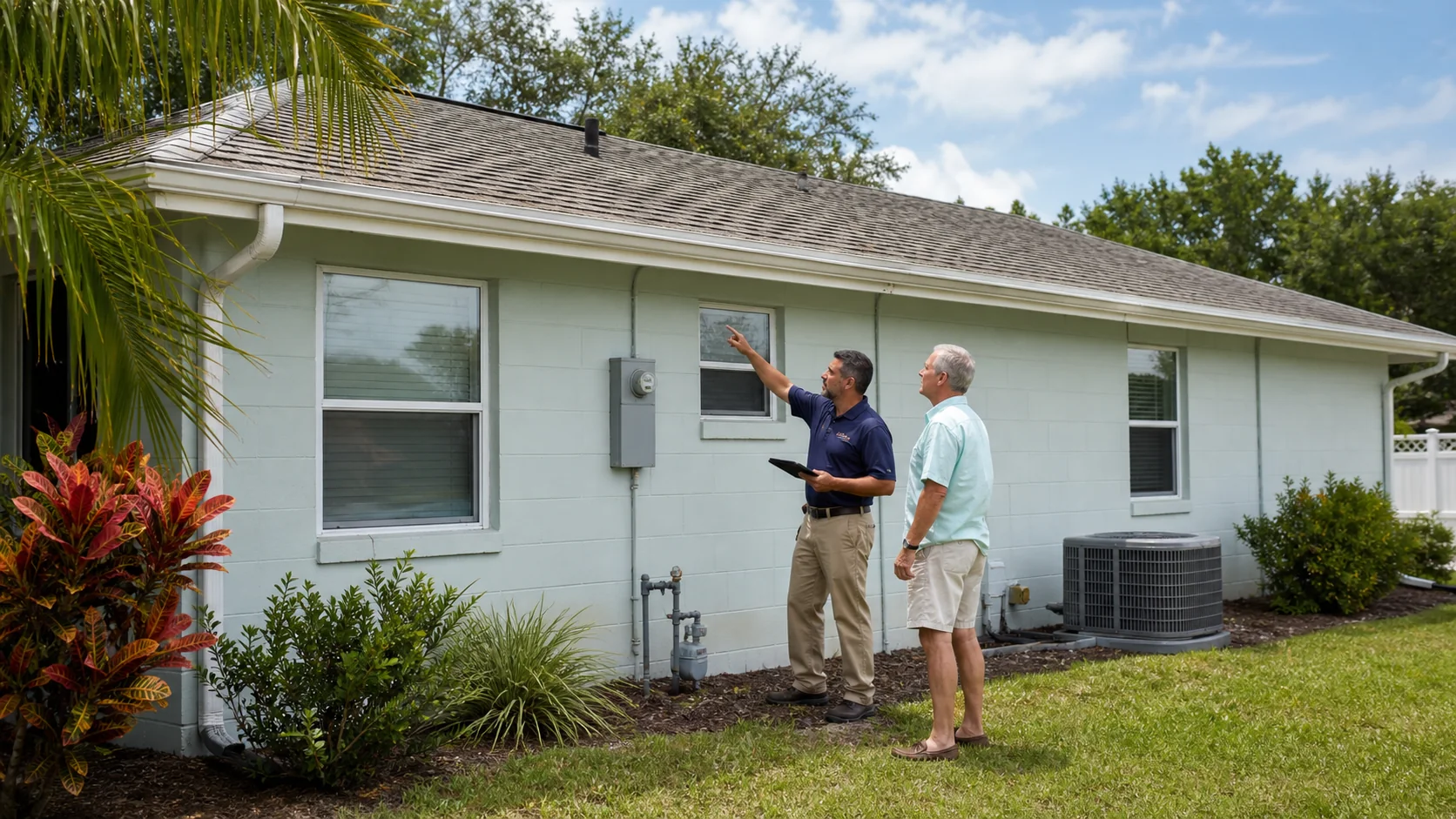
Construction type tells a carrier what the main outside walls are made from. Frame, masonry, and mixed homes can respond to wind, fire, and water in different ways.
Quick answers
How do carriers classify construction type: frame, masonry, masonry veneer?
Florida insurers generally sort a home into one of a small number of exterior-wall construction classes, adapted from the same construction-classification logic ISO uses industry-wide: Frame (exterior walls of wood or other combustible material), Masonry (exterior walls of concrete block, poured concrete, brick, or similar non-combustible material, usually defined as a minimum percentage of the wall area), and Masonry Veneer (a wood-frame structure with a masonry, stucco, or fiber-cement facade attached to the frame rather than load-bearing masonry). Citizens Property Insurance Corporation’s own underwriting manual (Rule 122) defines Frame construction as wood or other combustible exterior walls “including combinations with other materials such as brick veneer, stone veneer… and stucco on wood,” and defines Masonry as walls where at least two-thirds are non-reinforced masonry material. That means Citizens classifies a veneer-clad frame home as Frame, not Masonry. Universal Property & Casualty’s own Florida Personal Property Manual (Rule 106) draws the line differently: it states plainly that “Masonry Veneer is rated as Masonry,” while “Aluminum or Plastic Siding over Frame is rated as Frame.” So the same physical wall, a wood-frame structure faced in brick or stone, can be rated as masonry by one carrier and as frame by another. This is a carrier-specific difference that a homeowner cannot assume from general insurance knowledge.
Why does construction type affect wind rating in Florida?
Construction class has historically been a fire-rating tool. ISO’s building construction categories (Frame, Joisted Masonry, Non-Combustible, Masonry Non-Combustible, Modified Fire-Resistive, and Fire-Resistive) rank buildings from most to least combustible for fire pricing. Florida carriers layer a separate wind consideration on top of that, since the state is hurricane-exposed. Concrete-block (CBS) or poured-concrete exterior walls generally hold up better against wind-borne debris and lateral wind loads than wood-frame walls. So wall construction is one input carriers weigh when they price or restrict a policy, alongside the state’s official wind mitigation inspection factors: roof shape, roof-to-wall attachment, opening protection, roof covering type and age, and secondary water resistance, all captured on the OIR-B1-1802 wind mitigation form. Construction type and the wind mitigation credit are related but separate underwriting inputs. A masonry home with a poorly attached roof can still price worse than a well-retrofitted frame home. See our wind mitigation guide for what each inspection item checks and which credits it can earn. We are not publishing specific rate differentials here, because those vary by carrier, territory, and filing, and none of the carriers in this directory has published a public, apples-to-apples frame-vs-masonry rate comparison.
Note: This comparison reflects the carriers currently profiled in this directory. Not every carrier publishes a specific rule for this factor. Check each carrier’s own profile for the latest available information.
Frame vs masonry eligibility: carriers with a published rule
Four of the carriers in this directory have published something specific about frame-vs-masonry construction we could verify directly from that carrier’s own material, or from a source that names that carrier’s rule. The other 14 (American Traditions, American Integrity, Core Insurance, Edison Insurance, Florida Peninsula, Safepoint, People’s Trust, Patriot Select P&C, Ovation Home Insurance Exchange, Monarch National, Manatee Insurance Exchange, Homeowners Choice, Orchid, and GeoVera Specialty) have no public statement on frame-vs-masonry eligibility that we could verify, so they are not shown below.
- Universal Property & Casualty: Its Florida Personal Property Manual (Rule 106) defines Frame, Masonry Veneer, and Masonry as distinct rated classes, and states masonry veneer is rated as masonry while aluminum or plastic siding over frame is rated as frame. Source: carrier’s own filed manual.
- Slide Insurance: Its published Florida Homeowners Quick Reference Guide lists three eligible exterior classifications (frame, masonry veneer, and reinforced masonry) with reinforced-masonry status tied to construction date and county (for example, automatic reinforced-masonry classification for qualifying construction after 2001 statewide). Source: carrier’s own guideline document.
- Citizens Property Insurance Corporation: Its underwriting manual (Rule 122) defines Frame as wood or other combustible exterior walls, including brick- or stone-veneer-clad wood walls, and Masonry as at least two-thirds non-reinforced masonry exterior walls, notably classifying veneer-over-frame homes as Frame, the opposite of how Universal rates the same construction. Source: carrier’s own filed manual.
- Security First: Its own FAQ states that “frame houses usually cost more to insure than brick,” confirming the carrier prices by construction type, but a full frame-vs-masonry eligibility rule is not published. Source: carrier’s own FAQ page (partial).

What is the difference between a manufactured, mobile and modular home for underwriting?
These three terms get used loosely, but underwriting treats them very differently. Manufactured and mobile homes are built entirely off-site on a permanent chassis and must comply with the federal Manufactured Home Construction and Safety Standards (the HUD Code), in effect since June 15, 1976: they carry a HUD data plate or certification label rather than a state building permit for the structure itself. Modular homes are also built off-site in sections, but to the same state or local building code that governs site-built homes (in Florida, the Florida Building Code, based on the International Residential Code) rather than the federal HUD Code. Once installed and permanently affixed, a modular home is typically classified as real property and underwritten more like a conventional site-built home than like a manufactured home. That distinction is not always automatic with every carrier, though: Slide Insurance’s own guideline specifically excludes “Modular Homes built prior to January 2002,” meaning even a carrier that generally treats modular construction as conventional can still apply a build-date cutoff. Always confirm how a specific carrier classifies your home rather than assuming the manufactured/modular label alone settles eligibility.
Which carriers in this directory write manufactured or mobile homes at all?
Manufactured and mobile home coverage is largely a separate specialty market in Florida. Most standard homeowners carriers exclude it outright, and that pattern held up in our research. Two carriers say no in their own filed materials. Universal Property & Casualty‘s binding guidelines state “No Mobile or Trailer Homes, No Manufactured or Modular Homes.” Slide Insurance‘s guideline lists “Manufactured and Mobile Homes” and pre-2002 modular homes among its ineligible construction types. Orchid‘s published eligibility page likewise states “No mobile, kit, or prefabricated homes.” On the other side, Citizens Property Insurance Corporation explicitly writes mobile and manufactured homes through dedicated policy forms: Mobile Homeowners (MHO-3, MW-2), Mobile Home Dwelling Fire (MDP-1, MD-1), and Mobile Home Tenant/Renters Contents (MHO-4), per its own published residential policy list. Third-party industry reporting describes American Traditions as one of the largest private-market writers of manufactured/mobile home policies in Florida, citing a book of roughly 66,000 such policies as of 2026. We could not independently confirm this on the carrier’s own site, which was undergoing a relaunch at the time of research. Treat it as a strong lead worth confirming directly with the carrier or an appointed agent, not as a fully verified fact. For the remaining 13 carriers (American Integrity, Core Insurance, Edison Insurance, Florida Peninsula, Security First, Safepoint, People’s Trust, Patriot Select P&C, Ovation Home Insurance Exchange, Monarch National, Manatee Insurance Exchange, Homeowners Choice, and GeoVera Specialty) we found no public statement either confirming or excluding manufactured/mobile homes. Treat their manufactured-home eligibility as not published rather than assuming either answer.
How construction type interacts with roof age and year built
Construction type does not operate in isolation: it stacks with a home’s age and roof condition. An older frame home can draw more underwriting scrutiny than an older masonry home of the same age, since wood-frame construction is more likely to have aging structural connections, older wiring or plumbing, and roofing not built to current wind-uplift standards, while a CBS structure’s walls hold up structurally even when its systems need updating. But this varies by carrier rather than following one universal rule. Slide Insurance’s own guideline is a concrete example of the interaction: reinforced-masonry classification is tied to both construction year and county (automatic in Miami-Dade, Broward, and Palm Beach for qualifying construction after 1995, and statewide after 2001), and separately, homes 50 years or older must show evidence of updates to electrical, plumbing, HVAC, and roofing within the last 15 years regardless of whether they are frame or masonry. In practice, construction type, year built, and roof age are three separate questions a carrier asks, and a strong answer on one does not offset a weak answer on another.
Frequently asked questions
Does masonry construction always cost less to insure than frame in Florida?
Not universally, but it is a common pattern. Security First’s own FAQ states frame houses usually cost more to insure than brick, and Universal and Citizens both rate frame and masonry as distinct classes. The size of any difference, and whether it applies to your specific home, depends on the carrier, territory, and the rest of your risk profile. There is no single statewide discount amount we can publish.
Is masonry veneer treated as masonry or frame for insurance purposes?
It depends on the carrier, and the two carriers we could verify disagree with each other. Universal Property & Casualty rates masonry veneer as masonry. Citizens Property Insurance Corporation’s manual defines veneer-clad wood-frame walls as Frame construction. Do not assume either answer for a carrier not listed here as verified.
Will a manufactured or mobile home disqualify me from most Florida homeowners carriers?
For most of the standard carriers in this directory, yes. Universal, Slide, and Orchid all explicitly exclude manufactured, mobile, and (in some cases) older modular homes. Citizens and, per third-party reporting, American Traditions are exceptions that write this property type directly. If you own a manufactured or mobile home, an independent agent can point you to the specialty market rather than the standard homeowners market; you can also request a quote.
Is a modular home treated the same as a site-built home?
Generally yes, once it is permanently installed and classified as real property built to the state/local building code, but not automatically with every carrier. Slide Insurance, for example, excludes modular homes built before January 2002. Confirm the build date and classification with the specific carrier rather than assuming “modular” and “site-built” are always interchangeable.
Does construction type affect my wind mitigation discount?
They are related but separate. Construction type (frame vs. masonry) is about wall material. Florida’s wind mitigation credit, captured on the OIR-B1-1802 inspection form, is about roof shape, roof-to-wall connections, opening protection, roof covering, and secondary water resistance. A masonry home with an unprotected roof can still lose most of its wind mitigation credit, and a frame home with strong wind mitigation features can still recover some of that ground.
What does “No current public rule identified” mean in the table above?
It means we searched that carrier’s own published materials and other sources that name that carrier specifically, and did not find a construction-type or manufactured-home rule we could verify. It does not mean the carrier has no such rule, only that it is not publicly documented as of this page’s last verification date. Confirm directly with the carrier or an independent agent before assuming eligibility either way.
 Need a specific insurance company?
Get a quote from your Florida-licensed agent
Share a few details about your home, and our team will follow up to review your request and explain the next step.
- Florida-licensed agent
- Help with all property types
- No obligation
- Quotes typically back within 24 to 48 hours