Why does the year built affect home insurance?
The year built gives a carrier a quick clue about the home’s codes and major systems. It does not tell the whole story. A well-updated older home may be reviewed differently from one with original parts.
Quick answers
What carriers look at when underwriting a home’s year built
Across the carriers reviewed, only four publish a concrete, carrier-specific year-built or home-age underwriting rule: Patriot Select (homes built 1920 or later, 2002 or later in Monroe County), GeoVera Specialty (1950 or later, with 1950-1959 homes needing proof that wiring, plumbing and heating were fully renovated within the last 20 years), Florida Peninsula (homes 20 years and older must meet published roof, electrical, plumbing and HVAC condition standards), and Slide Insurance (a mandatory ACV settlement paired with a water exclusion on DP-3 risks 30 years and older).
Note: This comparison reflects the carriers currently profiled in this directory. Not every carrier publishes a specific rule for this factor. Check each carrier’s own profile for the latest available information.
Universal Property & Casualty and Citizens Property Insurance Corp were checked specifically given that both publish detailed underwriting and statutory manuals generally. Neither carrier’s public-facing site attaches a numeric year-built or home-age cutoff. Citizens’ consumer pages describe the HO-8 Modified Coverage Form as an option for homes that do not qualify for standard HO-3 coverage, a form traditionally associated with older housing stock, but the page stops short of stating any age or year figure.
For the remaining 14 carriers, no publicly posted year-built underwriting document could be located. That does not mean these carriers have no internal age rules; it means those rules are not published anywhere we could point to, so homeowners with an older home should confirm directly with the carrier or an independent agent rather than assume either way.
Year built eligibility by carrier: carriers with published information
Five of the carriers in this directory have published something specific about year-built or home-age eligibility we could verify directly from that carrier’s own material. The other 13 (American Integrity, American Traditions, Core Insurance, Edison Insurance, Homeowners Choice, Manatee Insurance Exchange, Monarch National, Orchid, Ovation Home Insurance Exchange, People’s Trust, Safepoint, Security First, and Universal Property & Casualty) have no public statement on year-built eligibility that we could verify, so they are not shown below.
- Citizens Property Insurance Corp: doesn’t publish a specific year-built or age limit; its HO-8 Modified Coverage Form is described as an option for homes that don’t qualify for standard HO-3 coverage, traditionally an older-housing-stock form, though Citizens doesn’t attach a specific year-built or age figure to it on its public site.
- Florida Peninsula: doesn’t publish an absolute minimum year built; instead it uses an age trigger: homes 20 years and older must meet Florida Peninsula’s published roof, electrical, plumbing and HVAC condition standards to be eligible.
- GeoVera Specialty: requires homes built 1950 or later to bind new business; homes built 1950-1959 need proof that wiring, plumbing and heating were fully renovated within the last 20 years.
- Patriot Select P&C: requires homes built 1920 or later (2002 or later in Monroe County) to bind new business; it hasn’t published separate rules for older homes beyond that cutoff.
- Slide Insurance: doesn’t publish an absolute minimum year built; instead it uses an age trigger at 30 years for DP-3 risks, applying a mandatory actual-cash-value settlement together with a water exclusion on DP-3 risks 30 years and older: a combination that can make the policy not worth binding.
What to do if your home is flagged for its year built
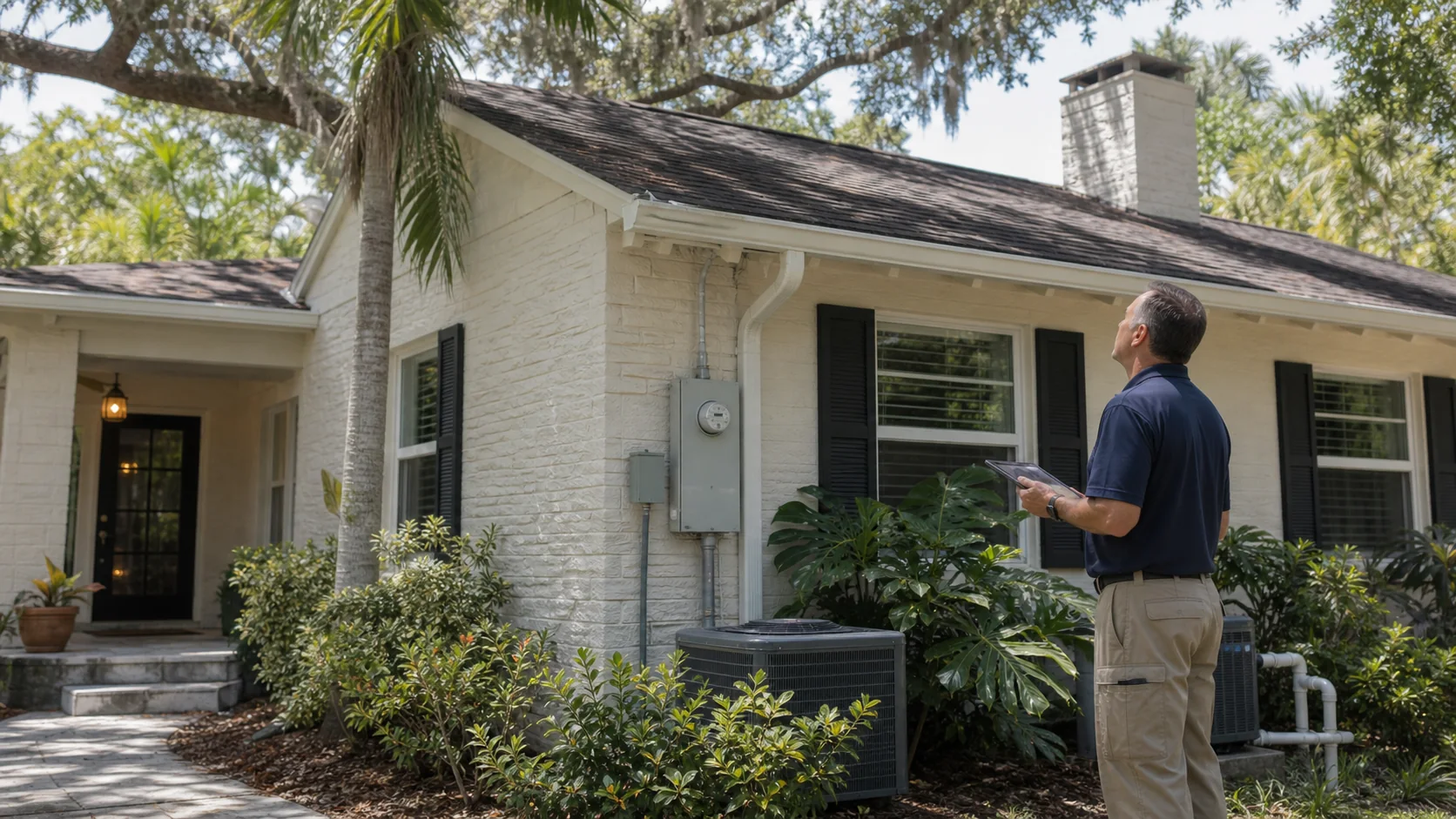
If a carrier declines or surcharges your home based on its age, the first step is finding out exactly which system triggered the decision. Most “age” declines are really about the roof, electrical panel, or plumbing, not the year on the deed. A recent four-point inspection report can document that those systems have already been updated, which is often enough to move a marginal application into an approvable one.
From there, compare that documentation against carriers with different published age rules: a home that doesn’t fit one carrier’s cutoff may fit another’s condition-based standard instead. See our inspections guide for what a four-point inspection checks, and use the eligibility hub to compare rules across all carriers before assuming a decline from one company applies everywhere.
How a home’s year built connects to other eligibility factors
A home’s year built rarely acts alone in underwriting: it’s usually a proxy for the condition of a handful of specific systems. The two factors most often tied to age are the roof’s age and the electrical panel and wiring, since older homes are statistically more likely to still have original versions of both. Plumbing material is a close third, particularly for homes built during the years polybutylene pipe was in common use.
Frequently asked questions
Is there a minimum year my home must have been built to get Florida homeowners insurance?
Only 2 of the carriers tracked here publish a specific year cutoff: Patriot Select requires homes built 1920 or later (2002 or later in Monroe County), and GeoVera Specialty requires 1950 or later, with 1950-1959 homes needing proof that wiring, plumbing and heating were fully renovated within the last 20 years.
Does Citizens Property Insurance have an age cutoff for older homes?
Citizens’ public site does not attach a specific year-built or age figure. It offers the HO-8 Modified Coverage Form for homes that don’t qualify for standard HO-3, a form traditionally associated with older housing stock, but doesn’t publish an age threshold for it.
What actually determines eligibility for an older home, if not its age?
The condition of four systems: roof, plumbing, electrical and HVAC. Florida Peninsula, for example, sets no absolute minimum year built but requires homes 20 years and older to meet its published roof, electrical, plumbing and HVAC condition standards.
What happens if my home is 30+ years old?
It depends on the carrier and system. Slide Insurance applies a mandatory ACV settlement paired with a water exclusion on DP-3 risks 30 years and older: a combination that can make a policy not worth binding. Check the specific systems rather than assuming age alone triggers a decline.
 Need a specific insurance company?
Get a quote from your Florida-licensed agent
Share a few details about your home, and our team will follow up to review your request and explain the next step.
- Florida-licensed agent
- Help with all property types
- No obligation
- Quotes typically back within 24 to 48 hours