What is ordinance or law coverage?
Ordinance or law coverage may pay added repair costs needed to meet current building codes after a covered loss. An older home may need work beyond replacing the damaged part.
Quick answers
What is ordinance or law coverage meant to address?
A standard homeowners policy is written to put your home back the way it was before the loss: what insurers call “like kind and quality.” It is not written to upgrade your home. Building codes, however, change over time. If your home predates the current Florida Building Code, a contractor rebuilding after a covered loss generally has to build to the code in effect today, not the code your home was originally built under. Ordinance or law coverage (sometimes labeled “Law and Ordinance” on a declarations page) is the piece of the policy that pays for that gap: the increased cost of construction to meet current code, the cost of demolishing or removing undamaged portions that code requires you to replace anyway, and any loss in value tied to a code-required change.
In Florida this isn’t an optional add-on you have to think to request. Under Florida Statute 627.7011, insurers are required to deem a homeowners policy as including ordinance or law coverage equal to 25% of the Coverage A (dwelling) limit, unless the policyholder declines it in writing. Insurers must also offer two elective choices when the policy is issued or renewed: a basic option that excludes the cost of complying with laws or ordinances altogether, or an enhanced option letting you choose 25% or 50% of the dwelling limit. Some carriers offer buy-up amounts beyond that, and the statute doesn’t prohibit an insurer from offering a guaranteed replacement cost policy instead.
Why can a covered repair still leave you with an uncovered bill?
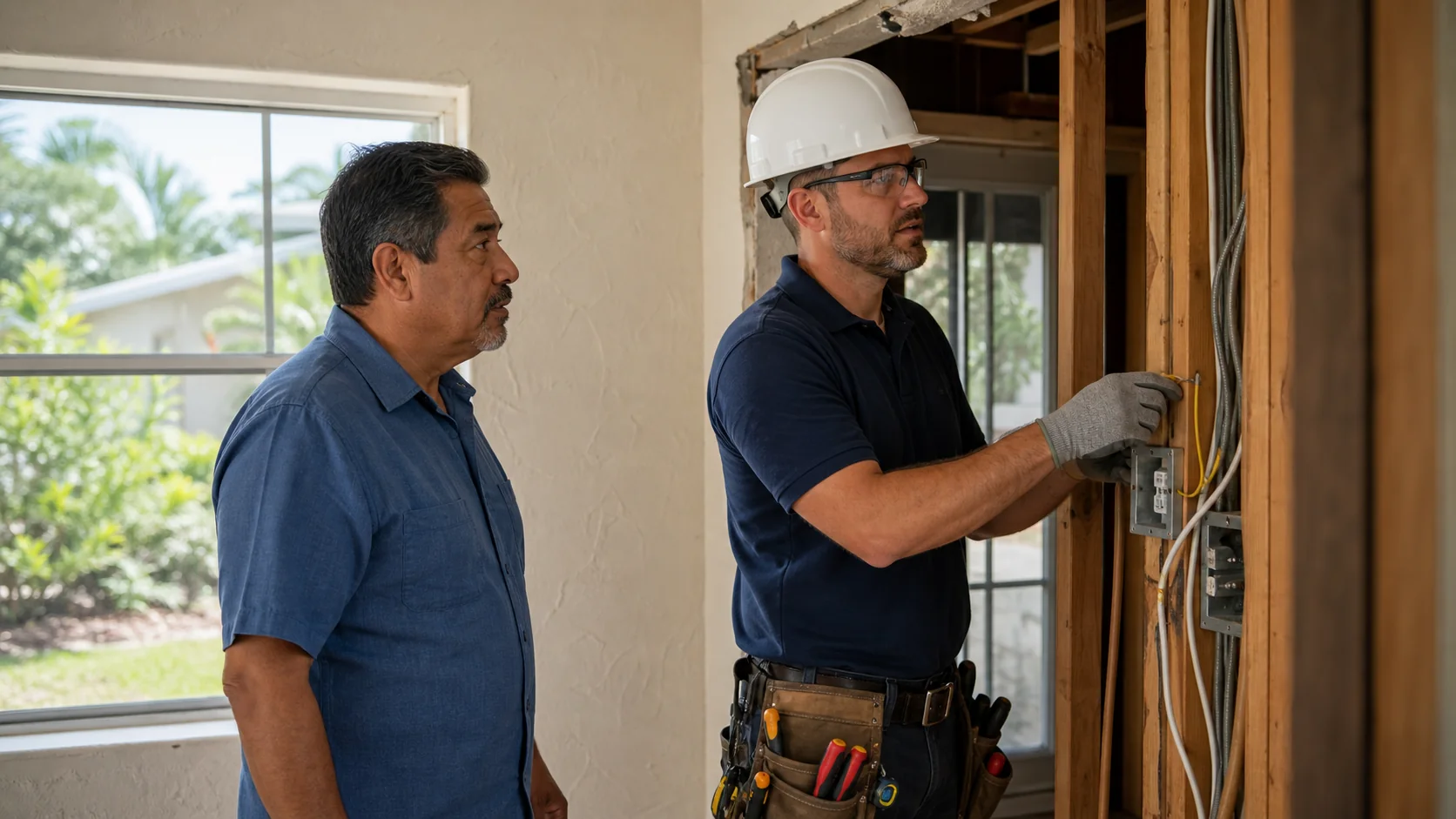
The cause of loss being covered and the full cost of repair being covered are two different questions. Say wind damage destroys part of a roof and that damage is a covered peril. Coverage A pays to repair or replace the damaged portion. But if the extent of that damage is enough to trigger a Florida Building Code requirement that the entire roofing system be brought up to current code, the cost of that extra, undamaged-but-now-required work falls outside ordinary dwelling coverage. That’s the specific gap ordinance or law coverage is meant to fill. It pays for the code-required work that goes beyond simply restoring what was damaged.
Two limits matter here. First, ordinance or law coverage only responds when the underlying loss is itself covered by the policy. It does not create coverage for an excluded cause of loss, and it does not pay for voluntary upgrades or remodeling unconnected to a covered claim. Second, the coverage carries its own limit, expressed as a percentage of Coverage A. If the actual cost of code compliance exceeds that percentage, the difference is out of pocket, even though the underlying damage itself was covered.
How is ordinance or law coverage usually expressed: a percentage of Coverage A?
Yes. On a Florida homeowners policy, ordinance or law coverage is set as a percentage of the Coverage A dwelling limit: commonly 25% by default, with an option to increase it to 50%, and higher buy-up amounts available from some carriers. A $300,000 Coverage A limit with the default 25% ordinance or law coverage means up to $75,000 is available for code-upgrade costs tied to a covered loss, on top of the dwelling limit itself. Industry guidance generally describes ordinance or law coverage as additional insurance rather than a sublimit carved out of Coverage A, though the exact policy language should be confirmed on your own declarations page, since wording varies by carrier and form.
Because it is tied to Coverage A, the dollar amount of ordinance or law coverage moves whenever your dwelling limit changes at renewal. It’s worth checking after any renewal where Coverage A was adjusted (for replacement cost increases, an inflation guard endorsement, or a carrier-initiated valuation update) to see whether the ordinance or law dollar amount kept pace with what a code-compliant rebuild would cost in your area.
When does Florida’s building code make this coverage relevant to a roof claim?
Roofs are where this coverage most commonly matters in Florida. Under the Florida Building Code, if more than 25% of a roofing system or roof section needs to be repaired, replaced, or recovered within a 12-month period, the code has historically required the entire roof to be brought up to current code, not just the damaged 25%. That is the origin of what is commonly called Florida’s “25% roof replacement rule.”
The rule was narrowed by 2022’s Senate Bill 4-D, which amended Section 553.844 of the Florida Statutes. Under that provision, if an existing roofing system or roof section was built, repaired, or replaced in compliance with the 2007 Florida Building Code or a later edition (in practice, a roof properly permitted after March 1, 2009, when the 2007 code took effect) only the actual repaired, replaced, or recovered portion has to meet current code, even if that portion exceeds 25% of the roof. The full-roof trigger still applies to older roofs that predate that compliance threshold.
The practical effect: on an older home with a pre-2009 roof, a covered wind or hail claim that damages roughly a quarter or more of the roof can turn a straightforward repair into a full roof replacement as a matter of code, regardless of what the insurer would otherwise have paid for a partial repair. Ordinance or law coverage is what is meant to absorb the added cost of replacing the undamaged three-quarters of that roof. On a newer, properly permitted roof, that specific trigger generally doesn’t apply, though ordinance or law coverage can still come into play for other code-driven costs on the same claim, such as updated flashing, underlayment, or attachment standards.
What should you look for on the declarations page?
Three things are worth confirming directly on your policy rather than assuming. First, whether ordinance or law coverage is present at all and, if so, at what percentage of Coverage A. The default is 25%, but it can be reduced (if you declined it in writing) or increased to 50% or more. Second, whether that percentage is stated as a flat dollar figure or a percentage that recalculates with Coverage A, since a stale dollar amount from an old renewal may no longer reflect current construction costs. Third, whether the coverage is listed as an endorsement with its own line and limit, separate from Coverage A, or bundled into broader replacement cost language. The declarations page or policy jacket should spell this out. If it doesn’t, that’s a question for your agent or carrier before a claim, not after.
It’s also worth asking, specifically for an older home, whether your roof’s permit history is documented and whether it was permitted under the 2007 Florida Building Code or later. That record is what determines whether the narrowed 25% rule applies to your roof, and having it on hand can matter during a claim.
Frequently asked questions
Do I have to buy ordinance or law coverage, or is it automatic?
It’s automatic. Under Florida Statute 627.7011, insurers must include ordinance or law coverage equal to 25% of your Coverage A dwelling limit unless you decline it in writing. Insurers also have to offer you the choice to increase it to 50%, or to exclude it entirely.
Does ordinance or law coverage pay for a full roof replacement on any covered claim?
Only when the code-required trigger applies. On a roof that predates the 2007 Florida Building Code (in practice, one not properly permitted after March 1, 2009), a covered claim damaging roughly 25% or more of the roof can require the whole roof to be brought up to current code. That full-roof trigger was narrowed by 2022’s SB 4-D for roofs already permitted under the 2007 code or later.
Is ordinance or law coverage a separate limit, or does it eat into my Coverage A?
Industry guidance generally describes it as additional insurance on top of Coverage A, not a sublimit carved out of it, but the exact policy language varies by carrier and form. Confirm how your specific declarations page and endorsement describe it.
Does a newer, code-compliant roof still need this coverage?
The full-roof 25% trigger generally doesn’t apply once a roof was properly permitted under the 2007 Florida Building Code or later. Ordinance or law coverage can still matter on a newer roof for other code-driven costs on a claim, such as updated flashing, underlayment, or attachment standards.
Can I increase my ordinance or law coverage above the default 25%?
Yes. Florida insurers must offer an enhanced option of 25% or 50% of Coverage A, and some carriers offer buy-up amounts beyond that. Ask your agent what your specific carrier makes available.
Does ordinance or law coverage pay for upgrades or remodeling I want, not just what code requires?
No. It only pays code-required costs tied to a covered loss. It never pays for voluntary remodeling or upgrades unconnected to a claim.
 Need a specific insurance company?
Get a quote from your Florida-licensed agent
Share a few details about your home, and our team will follow up to review your request and explain the next step.
- Florida-licensed agent
- Help with all property types
- No obligation
- Quotes typically back within 24 to 48 hours