How does roof age affect home insurance?
Carriers look at more than the year a roof was installed. They may also review its material, condition, permit, shape, remaining useful life, and how a roof loss would be paid.
Quick answers
What carriers look at when underwriting your roof’s age
We reviewed publicly accessible underwriting materials for all carriers to see what each one publishes about roof age, as opposed to what general industry blog posts claim on their behalf. Only five carriers had a locatable, carrier-attributable document stating specific roof-age figures: Citizens Property Insurance Corp, Florida Peninsula, People’s Trust, Slide Insurance, and Universal Property & Casualty. American Traditions references a named roof-related settlement schedule through its agency partner, but the specific age thresholds in that document were not accessible.
Note: This comparison reflects the carriers currently profiled in this directory. Not every carrier publishes a specific rule for this factor. Check each carrier’s own profile for the latest available information.
Among the carriers with published figures, the numbers vary considerably by roof material. Citizens draws a line at 25 years for shingle (“soft”) roofs and 50 years for tile, slate, concrete, or metal (“hard”) roofs, with a one-time exception if an inspection documents at least five years of remaining useful life. Universal Property & Casualty caps shingle roofs at 20 years and wood roofs at 15 years. Slide Insurance’s January 2023 quick reference guide, the most recent version we could locate, accepted tile and standing-seam metal roofs under 31 years and every other roof type, including shingle, under 16 years. Florida Peninsula’s located guide (a 2018 edition) puts shingle at under 20 years and flat roofing at under 10 years, and People’s Trust publishes separate, tighter limits for Miami-Dade, Broward, and Palm Beach counties than for the rest of the state.
For the remaining 13 carriers (American Integrity, Core Insurance, Edison Insurance, GeoVera Specialty, Homeowners Choice, Manatee Insurance Exchange, Monarch National, Orchid, Ovation Home Insurance Exchange, Patriot Select P&C, Safepoint, and Security First, plus American Traditions’ specific figures) no publicly posted roof-age underwriting document could be located despite direct searches of each carrier’s own site, its managing general agency partners, and FLOIR filing pages. That does not mean these carriers have no internal roof-age rules. It means those rules are not published anywhere we could point to, so they are not shown individually in the table below. Homeowners should confirm directly with the carrier or their agent before assuming an age cutoff.
Roof age eligibility by carrier: carriers with published figures
Five of the carriers in this directory have published a specific roof-age figure we could verify directly from that carrier’s own material. The other 13 (American Integrity, American Traditions, Core Insurance, Edison Insurance, GeoVera Specialty, Homeowners Choice, Manatee Insurance Exchange, Monarch National, Orchid, Ovation Home Insurance Exchange, Patriot Select P&C, Safepoint, and Security First) have no published roof-age figure that we could verify, so they are not shown below.
- Citizens Property Insurance Corp: soft roofs (shingle and similar materials) must not exceed 25 years; hard roofs (tile, slate, concrete, metal) must not exceed 50 years, per Citizens’ published roof rule bulletins. A roof past the age threshold can still qualify if a 4-Point Inspection Form or Roof Inspection Form documents at least 5 years of remaining useful life, extending coverage for up to 5 years, limited to one time per property; Citizens sends a courtesy notice when documented remaining life reaches 1 year or less.
- Florida Peninsula: per its Agent Quick Reference Guide (2018 edition, the most recent version located, so current guidelines may differ), asphalt shingle roofing should be under 20 years old and flat roofing should be under 10 years old, with no specific numeric age limit for tile or metal roofs in that document. Shingle roofs must also show no consistent lifting, curling, or granular loss, with a minimum of 3 years’ remaining serviceable life, and dwellings 40+ years old require an acceptable 4-Point Inspection at application.
- People’s Trust: per its published agent training guide, limits vary by region and material. For the rest of Florida: tile, concrete, or metal roofs must be 30 years or newer, shingle or cedar shake 20 years or newer, and flat roofs 15 years or newer. In the Tri-County area (Miami-Dade, Broward, Palm Beach), those limits tighten to 20 years for tile/concrete/metal, 10 years for shingle/cedar shake, and 10 years for flat roofs. Age restrictions do not apply to flat roofs over non-living area or space, and no separate settlement-basis or mandatory-inspection age trigger is stated beyond these eligibility limits.
- Slide Insurance: per its Florida Homeowners Quick Reference Guide dated January 2023 (HO3 and HO6), found on a third-party quoting platform rather than Slide’s own website, risks with tile or standing-seam metal roofs 31 years or older are ineligible for coverage, and risks with any other roof type (including shingle) 16 years or older are ineligible. We could not find a current version on Slide’s public website, so confirm the current rule with an agent appointed with Slide. Unapproved roof coverings (tar and gravel, rolled roofing, wood shake, boards, tar paper, and multi-layer roofs) are excluded outright, and all roofs are subject to underwriting review; a Windstorm/Hail Loss to Roof Surfacing endorsement is available for premium reduction.
- Universal Property & Casualty: per its Florida Underwriting Binding Guidelines, shingle roofs must be 20 years or newer (except on HO8 and DP1 forms), wood roofs must be 15 years or newer, and all other roof types must be “in good condition,” with no numeric age cap stated in that document. Dwellings over 100 years old must be written at Actual Cash Value on the HO8 form, a 4-Point Inspection is required for homes older than 40 years (except HO4, HO6, HO8 forms), and a 100% hip-roof wind mitigation credit requires photo evidence or an official OIR-B1-1802 inspection form.
What to do if your home is flagged for your roof’s age
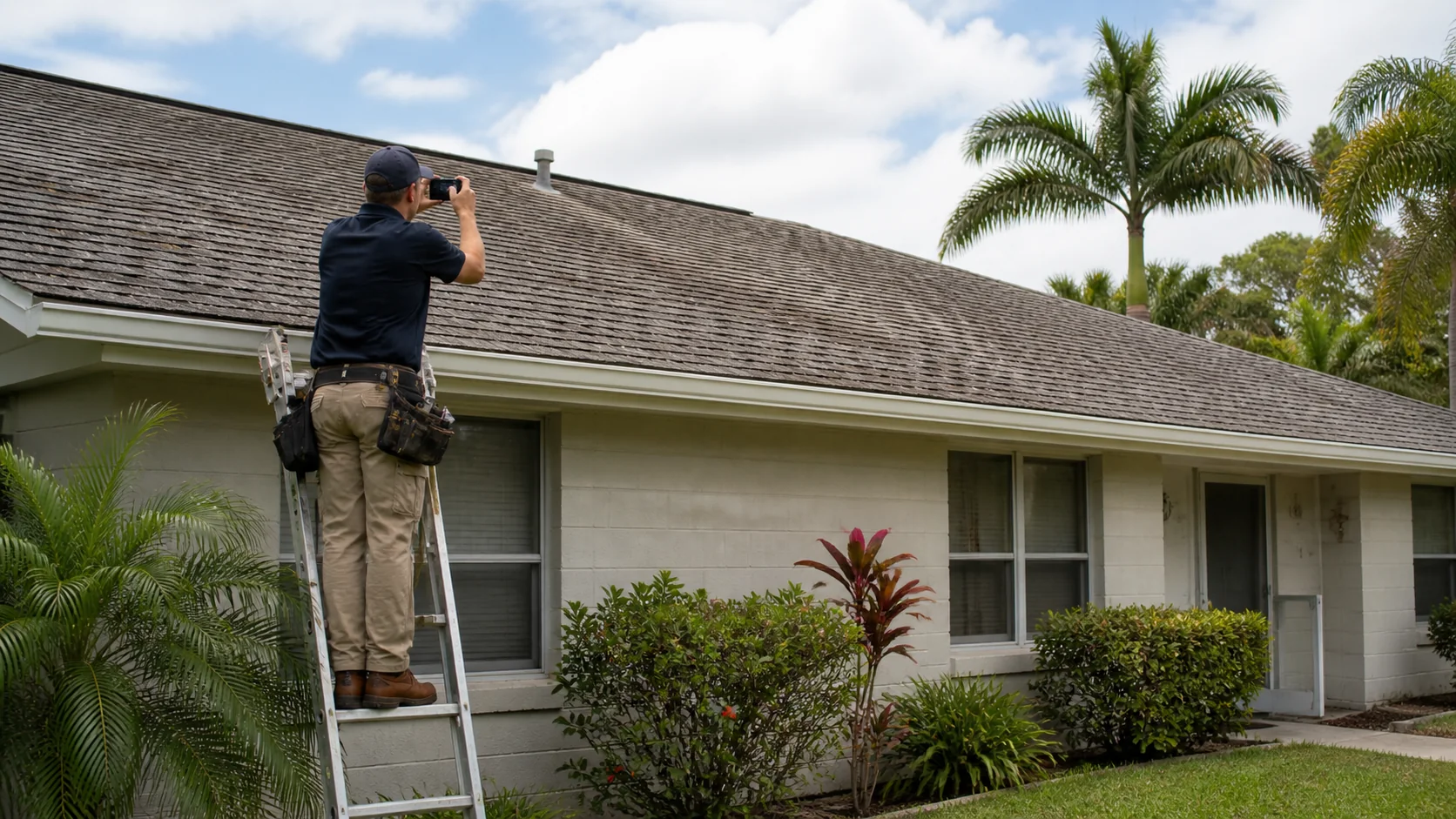
If your roof was flagged for age, a roof certification or wind mitigation inspection is the standard next step. It documents the roof’s current condition and remaining useful life rather than relying on age alone, and several carriers explicitly accept a passing inspection as an exception to their normal age cutoff. Keep the inspection report and any permit for prior roof work. Both are commonly requested directly during underwriting.
If your roof genuinely needs replacement to qualify, compare the cost against the premium difference across carriers first: some carriers price an aging roof rather than declining it outright, so a full check via the eligibility hub may turn up an option that doesn’t require replacement immediately.
How your roof’s age connects to other eligibility factors
Roof age is the single factor most closely tied to a home’s year built, though the two aren’t identical. A roof replaced five years ago on a 1970s home resets the roof-age clock even though the year-built figure doesn’t change. Roof material and condition are also documented on the same four-point or wind mitigation inspection that reviews electrical and plumbing, so it’s often efficient to address all three at once.
Frequently asked questions
Can I insure a home with a 20 year old roof in Florida?
It depends on the roof material and the carrier. Universal Property & Casualty caps shingle roofs at 20 years, while wood roofs are capped at 15 years. Citizens allows shingle (‘soft’) roofs up to 25 years, and Slide’s January 2023 guide accepted most non-tile/metal roof types only under 16 years, so a 20-year-old shingle roof could be eligible with one carrier and ineligible with another.
What about a 15 year old roof: is that too old?
Generally no, based on the published limits reviewed. Most carriers with published roof-age rules set their shingle limits at 20-25 years, so a 15-year-old roof falls under nearly every published threshold: Slide’s January 2023 guide is the exception, capping most non-tile/metal roofs under 16 years.
Do tile or metal roofs get more time than shingle roofs?
Yes, consistently. Citizens allows tile, slate, concrete, or metal (‘hard’) roofs up to 50 years versus 25 for shingle; Slide’s January 2023 guide accepted tile or standing-seam metal under 31 years versus under 16 for other types; People’s Trust allows tile/concrete/metal up to 30 years (20 in Miami-Dade, Broward, and Palm Beach) versus 20 years for shingle/cedar shake in the rest of the state.
My roof is past the age limit: can an inspection still save my policy?
With Citizens, yes. A 4-Point or Roof Inspection Form showing at least 5 years of remaining useful life extends eligibility for up to 5 years, limited to one time per property. Other carriers with published age limits don’t describe a similar inspection-based exception in the documents reviewed, so ask the specific carrier directly.
Why do roof-age rules vary so much by county?
At least one carrier, People’s Trust, sets tighter limits for Miami-Dade, Broward, and Palm Beach counties than for the rest of Florida (shingle roofs capped at 10 years there versus 20 years elsewhere), reflecting the higher wind/storm risk in that tri-county area.
 Need a specific insurance company?
Get a quote from your Florida-licensed agent
Share a few details about your home, and our team will follow up to review your request and explain the next step.
- Florida-licensed agent
- Help with all property types
- No obligation
- Quotes typically back within 24 to 48 hours