How much does Florida home insurance cost, by property type?
A condo, a mobile home, and a coastal single-family house are priced from completely different data. Here is what I typically see in real quotes for each property type, and what moves the number for a specific address.
Quick answers
Based on real quotes I’ve seen, October 2024 to September 2026. Last verified: September 2026.
What I See in Florida Quotes, by Property Type
These ranges come from real home insurance quotes I’ve seen between October 2024 and September 2026. They include every carrier that quoted, not just the policy the homeowner chose. Each card shows the median quote up to the higher end of what I see (the 75th percentile), rounded. I don’t have quotes from every part of Florida. Most come from the Tampa Bay area, so these are ranges I typically see in certain areas, not a statewide average.
Please read: these are ranges I see, not your price.
- These numbers come from real quotes I’ve seen, mostly for homes in the Tampa Bay area and a few other parts of Florida. They show what I typically see in those areas, not what every Florida homeowner pays.
- Your price depends on many factors: your exact location and distance to the coast, roof age and type, year built, construction, wind-mitigation features, coverage amounts, deductibles, claims history, and which carriers are writing in your area.
- I show the median (half of the quotes were at or below it) up to the higher end (about three in four were at or below it), rounded. Some homes quote below these ranges, and some quote well above them.
- Nothing on this page is a quote or an offer of coverage. The only way to know your price is a quote for your address.
Median to higher end of the quotes I see.
See ranges by county →Median to higher end of the quotes I see. Covers the unit’s interior, contents and liability; the HOA insures the building.
Median to higher end of the quotes I see. Covers the structure and landlord liability, not the tenant’s belongings.
Median to higher end of the quotes I see. Age, tie-downs and wind coverage drive the spread.
Median to higher end of the quotes I see. A modified form some carriers use for older homes that don’t fit a standard HO-3.
Median to higher end of the quotes I see. Covers a tenant’s belongings and liability.
Single-family quotes by year built
The same single-family quotes, grouped by the year the home was built (rounded):
| Year built | Median | Higher end |
|---|---|---|
| Before 1980 | $4,000 | $5,800 |
| 1980 to 2001 | $5,500 | $8,700 |
| 2002 or newer | $3,200 | $4,800 |
Homes built in 2002 or later fall under the Florida Building Code, and their quotes run lowest. Homes built from 1980 to 2001 run highest in the quotes I see. Location and dwelling coverage also differ between these groups, so year built is one factor among several.
How the hurricane deductible changes the price
For single-family homes in Hillsborough County, the median price per $1,000 of dwelling coverage was about $12 with a 2% hurricane deductible, about $11 with 5%, and about $8 with 10% (only a few homes). A higher hurricane deductible lowers the premium but raises what you pay after a named storm. See the hurricane deductible guide.
Common Add-Ons and Discounts I See
I also look at the itemized lines on the home quotes I’ve seen. The amounts below are rounded estimates based on those quotes, for the add-ons and discounts I see most often. This is not a full list of what a policy can include, and amounts vary by carrier, home and coverage amount.
| Item | What I typically see |
|---|---|
| Add-ons (optional coverage) | |
| Replacement cost on personal property | About $700 a year (roughly 15% of the premium) |
| Water backup / sump overflow | About $25 a year |
| Identity theft | About $25 a year |
| Increased liability | About $15 a year |
| Increased medical payments | Under $10 a year |
| Increased ordinance or law | About $100 a year |
| Mold / fungi | About $150 a year |
| Credits and discounts | |
| Wind-mitigation credit | About $3,500 a year off (often around 45% of the premium) |
| Limited water damage coverage (credit) | About $400 a year off |
| Higher deductible credit | About $250 a year off |
| Claims-free discount | About $60 a year off |
| Surcharges | |
| Older home / year built surcharge | About $600 a year added (roughly 18% of the premium) |
What Actually Moves Your Price
The ranges above are starting points, not quotes. Within any single property type, the actual premium a carrier offers can swing by thousands of dollars based on the specifics of the home and the household. These are the factors that matter most in Florida underwriting.
Roof age and material
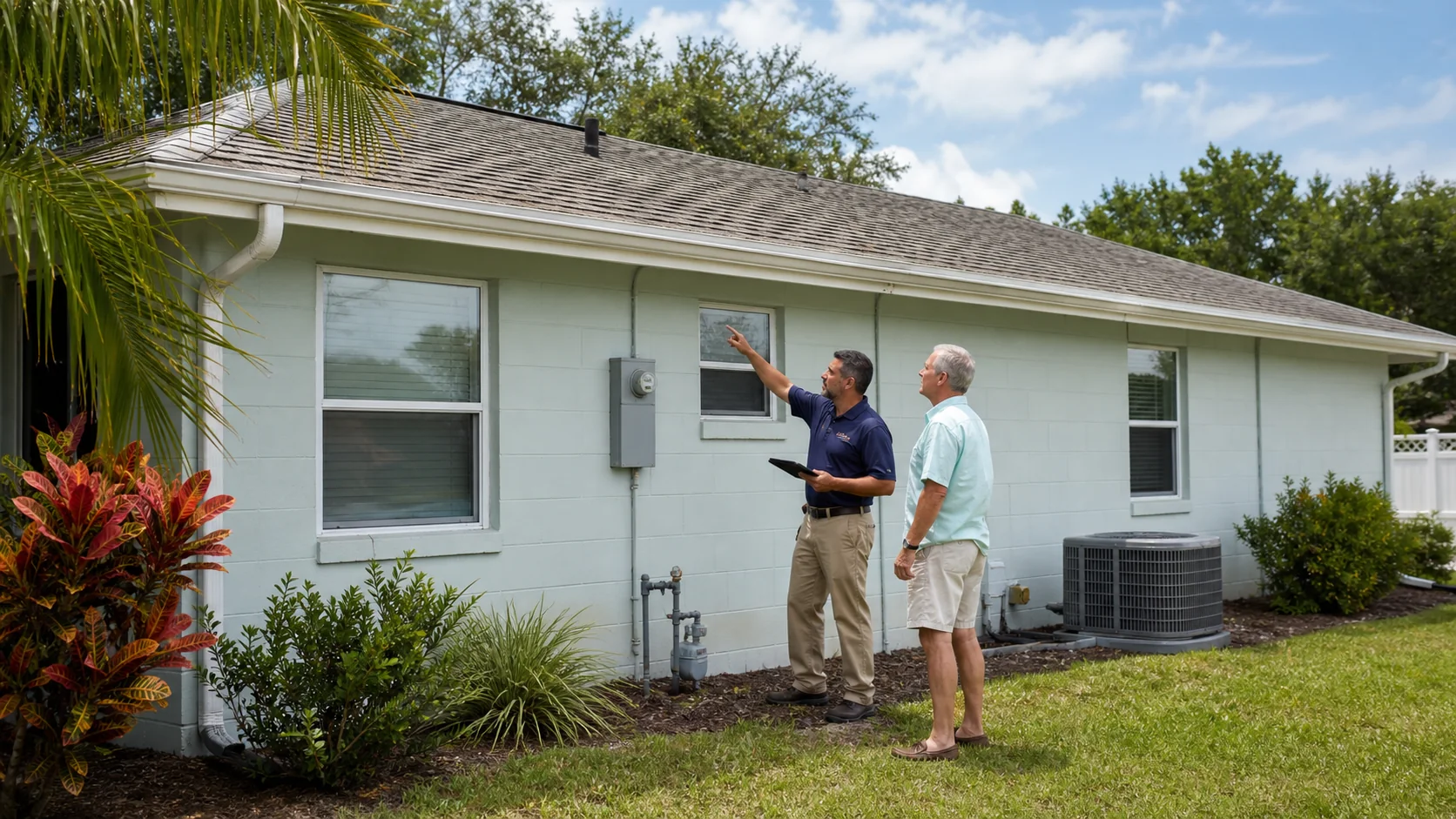
Roof age is the single largest lever most Florida homeowners can pull. Many carriers cap new-business eligibility at 15-20 years of roof age regardless of condition, and several offer meaningful premium credits for roofs under 10 years old or built to newer wind-resistance codes. A roof replacement can move a quote from decline to approval, or shave hundreds off the annual premium. See our roof age eligibility guide for carrier-by-carrier cutoffs.
Construction type
Concrete block and masonry construction generally prices lower than frame construction in wind-exposed areas, since block performs better in the wind and hail models carriers use to set rates. Manufactured and mobile homes are priced on a separate, and generally more limited, set of underwriting rules. See the manufactured-home figures above.
Hurricane deductible choice
Florida policies carry a separate percentage-based hurricane deductible, distinct from the standard all-other-perils deductible. Choosing a higher hurricane deductible (5% or 10% of Coverage A instead of 2%) lowers the annual premium in exchange for more out-of-pocket exposure after a named storm. Our hurricane deductible guide breaks down how the percentage is calculated and what it means in dollars at different dwelling limits.
Claims history
A home with prior water-damage or roof claims, even claims from a previous owner reported through CLUE, typically prices higher or faces tighter underwriting, particularly for water and mold coverage. Some carriers decline homes with more than one or two claims in the past 3-5 years outright.
Coverage limits and dwelling value
Premium scales with the dwelling coverage (Coverage A) limit, which should reflect the cost to rebuild the home, not its market value. Underinsuring to save on premium is a common and costly mistake. Our cost of homeowners insurance guide walks through how dwelling value and premium relate.
Distance to the coast
Wind and storm-surge risk both increase closer to the coastline, and most carriers’ rating models reflect that directly. Two otherwise identical homes a few miles apart can see meaningfully different quotes if one sits closer to open water.
Citizens vs. the private market
Citizens Property Insurance Corporation is Florida’s state-run insurer of last resort, and its rates are set by statute rather than free-market pricing, which means Citizens is sometimes cheaper and sometimes more expensive than a comparable private-market quote, depending on the area and property. Homeowners eligible for private coverage at a comparable or lower price are generally required to take it under Florida’s “clearinghouse” process. See our Citizens Property Insurance Corp profile for how that comparison works.
How to Compare Prices the Right Way
The biggest pricing mistake I see is comparing quotes with different coverage limits, different hurricane deductibles, or different endorsements side by side and assuming the cheaper number is the better deal. Before comparing any two quotes, confirm they carry the same Coverage A dwelling limit, the same hurricane deductible percentage, and the same set of endorsements (water backup, service line, ordinance & law, and so on). Otherwise, you are not comparing the same policy.
The most reliable way to see how your specific home prices across the Florida market is to work with a licensed independent agent who can run your address through multiple carriers at once, since eligibility and pricing both depend on details like roof permit history, four-point inspection results and prior claims that a self-serve calculator can’t fully account for. You can browse the carriers in our directory below, or use the form to request real quotes for your property.
 Want a real number for your home?
Get a quote from your Florida-licensed agent
Share a few details about your home, and our team will follow up to review your request and explain the next step.
- Florida-licensed agent
- Help with all property types
- No obligation
- Quotes typically back within 24 to 48 hours
Frequently asked questions
Are the prices on this page a real quote?
No. These ranges come from real quotes I’ve seen for other Florida homes, mostly in the Tampa Bay area, between October 2024 and September 2026. They are not a quote for your home and not what everyone pays. Your actual premium depends on your roof, construction, coverage limits, deductible choices, claims history, and which carrier is quoting. The only way to get a real number is to request quotes for your specific address.
Why is my quote higher than the ranges shown here?
Averages and medians blend homes with newer roofs, lower coverage limits, and cleaner claims histories together with homes that carry more risk. An older roof, a higher dwelling limit, a prior water claim, or a coastal location can each push a quote above the market range on its own, and several together can push it well above.
Is Citizens Property Insurance cheaper than private carriers?
Sometimes. Citizens’ rates are set by statute rather than competitive pricing, so it can be cheaper than the private market in some counties and more expensive in others. Florida’s clearinghouse process generally requires homeowners to take a comparable or lower-priced private offer when one is available. See our Citizens Property Insurance Corp profile for more detail.
How often do Florida home insurance rates change?
Carriers can file for rate changes with the Florida Office of Insurance Regulation as often as market conditions and reinsurance costs require, and many Florida homeowners have seen at least one rate change at renewal in recent years. Because of this, treat any price range, including the ones on this page, as a snapshot, and confirm current pricing directly with a carrier or agent before relying on it.
Where to go next
Cost of homeowners insurance in Florida
What moves a Florida home insurance price.
Hurricane deductible, explained
How the percentage deductible changes your price.
Roof age eligibility
Why your roof is the biggest lever on price.
Carrier directory
Full profile for each carrier in our directory.
Pricing by county
Ranges for the counties where I have enough quotes.