Roof replacement insurance checklist
Ask the insurance agent what proof the carrier needs before work starts. A new roof can help, but it does not promise a quote or lower price.
Quick answers
Before the work starts: what should you tell your carrier or agent?
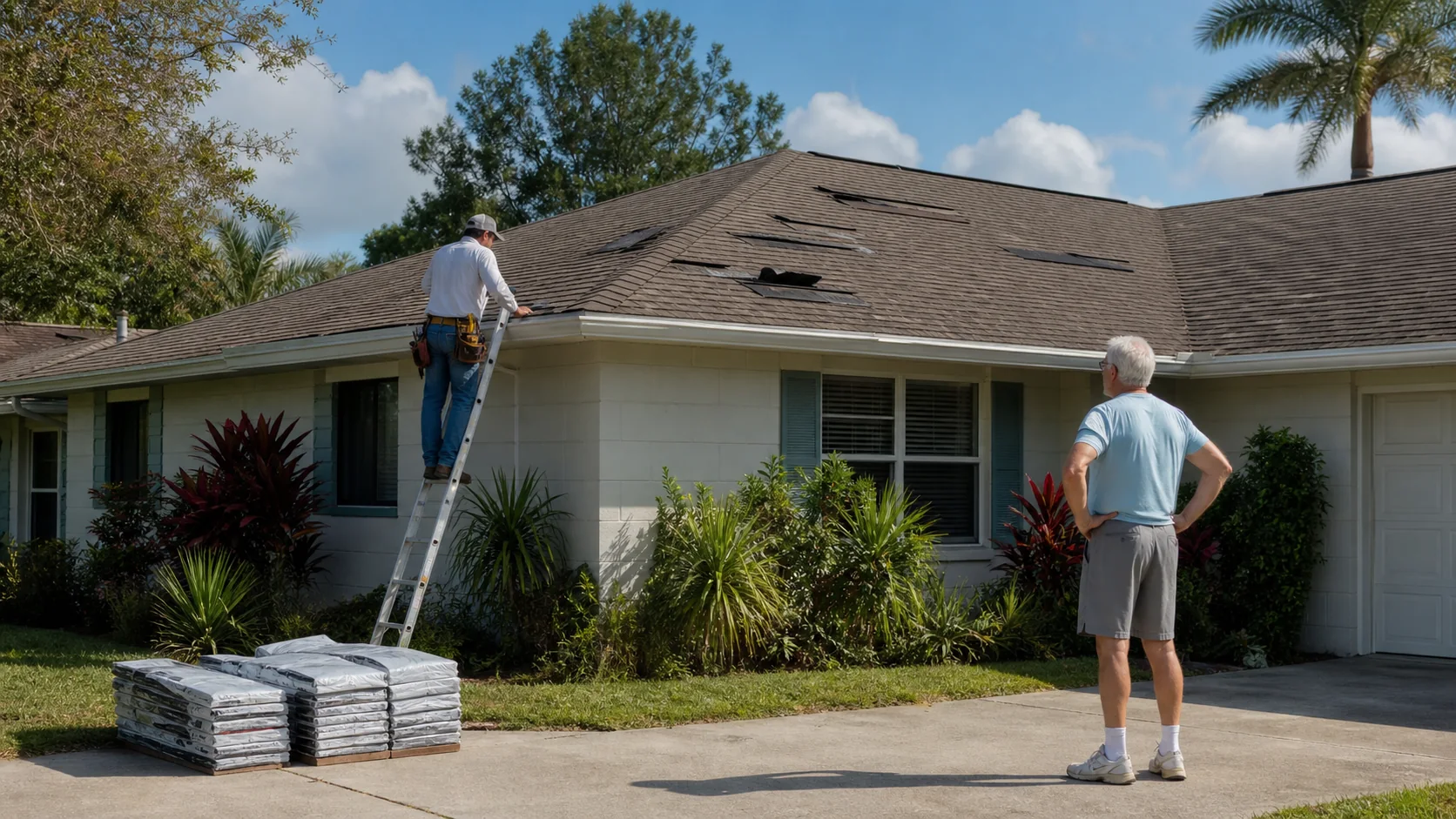
Call your agent or carrier before the roofer starts tearing off the old roof, not after. If the replacement is happening mid-term, meaning in the middle of your current policy period rather than at renewal, your insurer may want advance notice, particularly if the work will leave any part of the structure temporarily open to the weather (a partial tear-off, tarping overnight, or a multi-day job during hurricane season). Some policies require notice of material changes to the dwelling, and a full roof replacement typically counts. Ask directly whether the coverage on the dwelling changes at all while the roof is exposed, and whether the carrier wants updates as the job progresses. This is also the point to confirm the contractor is licensed and insured in Florida, since an unlicensed or uninsured crew can create liability exposure that has nothing to do with the roof itself.
What paperwork should the roofer leave you with?
A licensed Florida roofer should leave you with a signed contract describing the scope of work, the product or material specification sheet for whatever was installed (shingle brand and model, tile type, or metal panel profile, along with its wind rating), the manufacturer’s warranty documentation, and the permit number pulled for the job. Keep the itemized invoice as well. It lists the underlayment, fasteners, and flashing details that later feed into a wind mitigation inspection. Do not treat the roofer’s word that “it’s all filed with the county” as sufficient; ask for copies of everything in writing or as PDFs, since you will need to hand some of this to your carrier and some to whoever performs your next wind mitigation inspection.
Which documents does a carrier ask for afterward: permit, final inspection, roof certification?
Once the roof is on, most carriers want a receipt and proof the work was done to code. That generally means the building permit associated with the job, the final inspection sign-off from the local building department (the county or city confirms the work passed inspection and closes out the permit), and often a roof certification or wind mitigation inspection form. In Florida, that form is commonly the Office of Insurance Regulation’s Uniform Mitigation Verification Inspection Form, OIR-B1-1802, completed by a licensed inspector, contractor, engineer, or building official after the new roof is in place. Send copies of the permit, the final inspection, and any roof certification to your agent as soon as you have them so the file is updated before your next renewal review.
Does a new roof change your premium or your eligibility, and who do you ask?
A new roof frequently improves both. On the eligibility side, many Florida carriers restrict how old a roof can be before they will write or renew a policy: a new roof resets that clock and can open up carriers that had declined the home under its old roof. Florida law (Section 627.7011, Florida Statutes) also limits an insurer’s ability to deny coverage or refuse to renew a policy based on roof age alone when the roof is under 15 years old, or when an older roof passes an inspection showing at least five years of remaining useful life, though carriers can still act on what an inspection finds. On the premium side, a new roof’s materials, fasteners, and roof-to-wall connections are exactly what a wind mitigation inspection scores, so a new roof can raise your wind mitigation credits and lower the windstorm portion of your premium. None of this is automatic. It only shows up in your rate once the carrier has the documentation and, in most cases, a fresh wind mitigation report on file. Your agent is who you ask; they can tell you whether your specific carrier reprices mid-term on a roof change or waits until renewal.
If the roof is being replaced through a claim, what is different?
When the roof is being replaced because of a covered loss (storm damage, for example) the process runs alongside the claim rather than as a separate home improvement project. The contractor may deal directly with the adjuster to agree on scope and pricing, and it is common for a supplement to be filed if the roofer finds additional damage once the old roof is opened up that was not part of the original estimate. Keep every version of the estimate, the adjuster’s scope of work, and the final invoice, and reconcile the final invoice against the claim payout yourself rather than assuming they match. If the final cost differs from what the carrier issued, that gap is what a supplement or a follow-up call to the adjuster is meant to resolve. All the same post-replacement paperwork (permit, final inspection, and roof certification) still applies and still needs to reach your file.
What to keep for the next four-point or wind mitigation inspection
Hold onto the contract, the product spec sheet, the permit, the final inspection approval, and any wind mitigation form in one place, ideally both as physical copies and digital scans. A four-point inspection (which most carriers request on older homes regardless of roof status) will ask about the age and condition of the roof, and having the installation date and documentation on hand makes that inspection faster and less likely to flag the roof as a concern. For the wind mitigation side specifically, our Wind Mitigation Inspection guide covers what an inspector looks for and how each feature translates into a discount. The roof-related paperwork from this checklist is exactly what that inspection will draw on.
Frequently asked questions
Will homeowners insurance pay for a new roof?
Only when the replacement is triggered by a covered loss: storm, wind, fire, or similar damage recognized under your policy. In that case the claim, and any adjuster-agreed supplement, funds some or all of the replacement, subject to your deductible and whether the roof is covered at replacement cost or actual cash value. A roof replaced simply because of age or wear is not a covered event and is not paid for by the policy, though the new roof can still improve eligibility and lower your windstorm premium once documented, as covered below.
Do I have to tell my insurance company before I replace my roof?
Most policies do not require prior approval to do the work, but many do require notice of material changes to the dwelling, and a full roof replacement usually qualifies. Calling ahead avoids a coverage gap if the structure is temporarily exposed and gives the carrier a heads-up before the change shows up on an inspection.
Will my premium go up while the roof is being replaced?
Typically no. A roof replacement does not usually trigger a rate change mid-project; any rate change comes after the work is done and documented, once the carrier has the permit, inspection, and (often) a wind mitigation report reflecting the new roof.
Do I need a new wind mitigation inspection after replacing my roof?
In almost all cases, yes. Your prior wind mitigation report describes the old roof, so it no longer reflects your home. A new inspection is what lets the carrier apply any updated discount for the new materials and connections.
What if my roofer doesn’t pull a permit?
Do not accept that. Unpermitted roof work is difficult or impossible to document for insurance purposes, can complicate a future claim, and may not be enforceable under the manufacturer’s warranty. Confirm the permit number before final payment.
How long does the carrier take to update my premium after a new roof?
This varies by carrier and by whether the change applies mid-term or at your next renewal. Ask your agent directly when you submit the documentation, since some carriers reprice as soon as the file is updated and others hold the change for renewal.
Does a new roof automatically qualify me for every wind mitigation discount?
No. The discount depends on the specific features documented on the inspection form: roof covering, roof deck attachment, roof-to-wall connection, secondary water resistance, and opening protection are scored separately, so a new roof helps most when paired with upgrades like better fastening or impact-rated openings.
 Need a specific insurance company?
Get a quote from your Florida-licensed agent
Share a few details about your home, and our team will follow up to review your request and explain the next step.
- Florida-licensed agent
- Help with all property types
- No obligation
- Quotes typically back within 24 to 48 hours